Why grip socks matter for pilates and yoga
If you've ever slipped on a reformer carriage or felt your feet sliding during a yoga flow, you already know why grip socks exist. They're not a gimmick. They're the difference between focusing on your form and worrying about your footing.
Grip socks have rubberised pads on the sole that grip the surface beneath your feet. On a reformer, that means your feet stay locked on the carriage or footbar. On a yoga mat, it means your downward dog doesn't slowly turn into the splits. In a mat pilates class, it means stability through every roll-up, plank, and teaser.
This guide covers everything you need to know about choosing and wearing grip socks for pilates, reformer pilates, and yoga.
Reformer pilates grip socks: why they're essential
Reformer pilates is where grip socks really earn their keep. The carriage moves on rails, and your feet are either on the carriage itself, on the footbar, or in the straps. Every one of those contact points is a place where your foot can slip if you're barefoot or wearing regular socks.
The rubber pads on grip socks give you traction on the carriage surface. That traction lets you push through your feet with confidence, which means better engagement through your legs, glutes, and core. Without it, part of your brain is always managing balance instead of focusing on the movement.
Most reformer studios require grip socks as standard. It's partly a hygiene thing -- shared equipment stays cleaner when feet are covered -- but it's mainly about safety. A foot slipping off the footbar mid-press is a recipe for injury.
What to look for in reformer grip socks
Not all grip socks are built the same. For reformer work, you want:
- Full sole coverage. Some grip socks only have pads on the ball and heel. For reformer work, you want grip across the whole sole because your foot contacts the carriage at different angles depending on the exercise.
- A snug fit. Loose grip socks defeat the purpose. The sock needs to stay tight to your foot so the grip pads make proper contact with the surface. If the sock moves on your foot, you've just shifted the slipping problem from foot-to-surface to foot-to-sock.
- Durable grip pads. Cheap grip socks lose their grip after a few washes. The rubber pads flatten out or peel off. Look for quality rubber that's built into the fabric, not just printed on top.
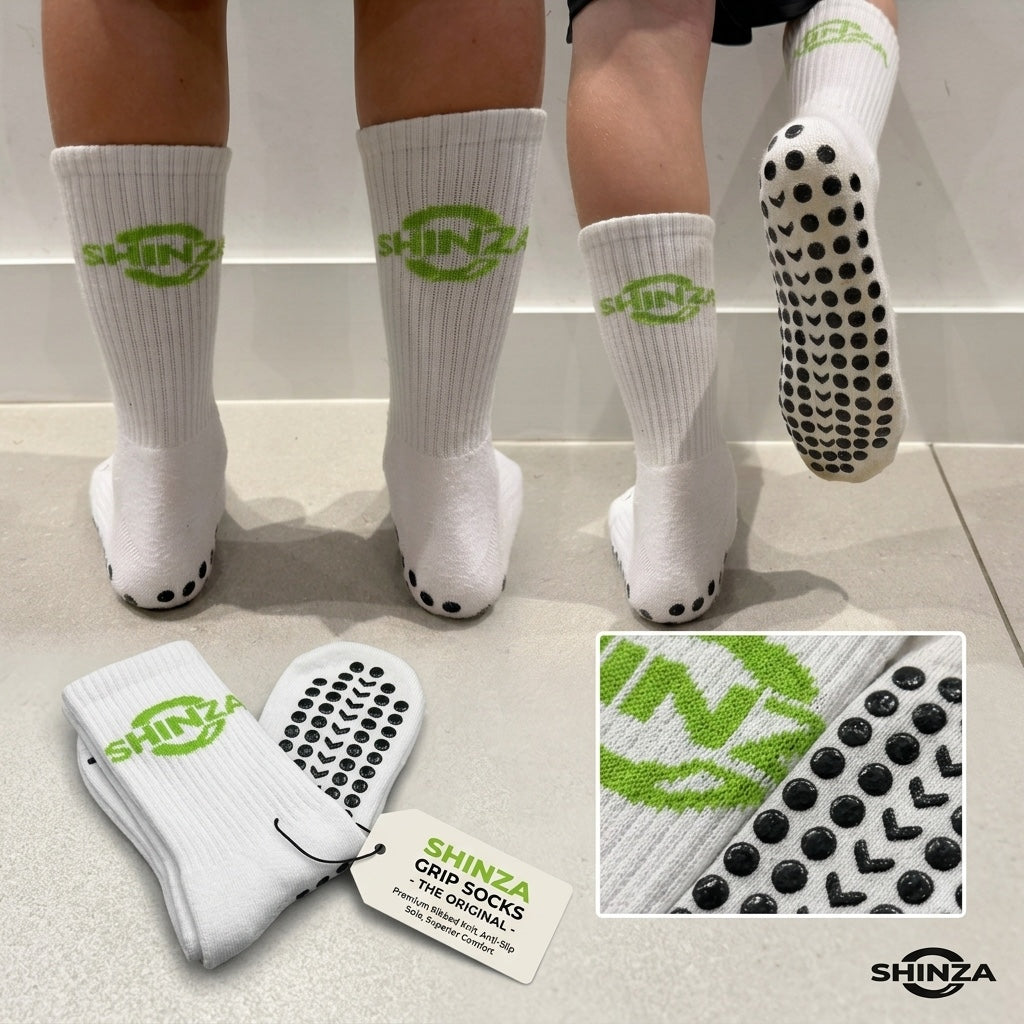
Shinza Performance
Grip Socks
Quality rubber grip pads across the full sole. Mid-weight comfort for studio sessions.
£15.00
Shop NowYoga grip socks: do you actually need them?
Yoga is traditionally practised barefoot, and there's nothing wrong with that if your mat gives you enough traction. But there are situations where grip socks make a real difference.
If you practise on a shared studio mat rather than your own, grip socks give you consistent traction regardless of how worn or slippery the mat is. If you run cold and find bare feet uncomfortable in a studio setting, grip socks keep your feet warm without sacrificing grip. And if you do hot yoga or tend to sweat through your feet, the moisture-wicking fabric in a good grip sock can actually give you better traction than bare skin on a wet mat.
For styles like vinyasa and power yoga where you're flowing between poses quickly, grip socks help you transition without readjusting your feet. For slower styles like yin or restorative, they're less critical but still nice for warmth and hygiene.
Mat pilates: the middle ground
Mat pilates falls somewhere between reformer and yoga in terms of how much you need grip socks. You're working on a fixed surface, so there's no moving carriage to worry about. But you're doing a lot of exercises where your feet are pressing into the mat -- bridging, footwork variations, standing balance work -- and grip socks make all of those more stable.
Most mat pilates studios don't require grip socks, but they're recommended. Once you've done a hundred with grip socks versus without, you'll notice the difference in how stable your feet feel and how much more you can focus on your core engagement rather than your foot placement.
Pilates grip socks vs football grip socks: what's the difference?
If you've seen grip socks marketed for football and wondered whether they're the same thing -- they largely are. The core technology is identical: rubberised pads on the sole to prevent slipping.
The main differences are in the cut and thickness. Some pilates-specific brands make thinner, lower-cut socks that sit below the ankle. Football grip socks tend to be mid-calf or crew length. But the grip itself works the same way regardless of the sport.
A quality grip sock designed for football works perfectly well on a reformer, a yoga mat, or a pilates studio floor. The grip pads don't know or care what sport you're doing. What matters is the quality of the rubber, the coverage of the pads, and the fit of the sock.
How to choose the right size
Sizing matters more with grip socks than regular socks because the whole point is that the sock doesn't move on your foot. A grip sock that's too big will bunch up and the pads won't make proper contact with the surface.
If you're between sizes, go down rather than up. Grip socks should feel snug when you first put them on. They'll give slightly with wear, so starting tight is better than starting loose.
Check the size guide before you buy and measure your foot if you're not sure. Most brands use UK shoe size ranges, so it's straightforward to match up.
Looking after your grip socks
The grip pads are the first thing to wear out, and how you wash them makes a big difference to how long they last.
Turn them inside out before washing. Use a cool cycle -- heat breaks down the rubber faster. Don't tumble dry them. Air dry only. The rubber pads will last significantly longer if you keep them away from high heat.
A good pair should last several months of regular use. When you notice the pads getting smooth and you're starting to slip, it's time for a new pair.
Common questions
Can I wear grip socks on a reformer without shoes?
Yes, that's exactly what they're designed for. You wear grip socks directly on the reformer -- no shoes needed. Most studios require grip socks specifically because they provide traction without the bulk or dirt of shoes.
Are grip socks better than being barefoot for yoga?
It depends on the situation. On your own mat in good condition, barefoot is fine. On shared mats, slippery surfaces, or if you tend to sweat through your feet, grip socks are better. They're also warmer, which matters in cooler studios.
Do I need special pilates grip socks or will any grip sock work?
Any quality grip sock with good rubber pads will work for pilates. You don't need a pilates-specific brand. What matters is the grip quality, the fit, and the durability -- not the label.
Can I wear the same grip socks for pilates and football?
Absolutely. The grip technology is the same. If you or your kids play football and do pilates or yoga, one pair of grip socks covers both.
Get a grip on your practice
Whether you're on a reformer three times a week, flowing through yoga every morning, or just starting mat pilates, grip socks are a small investment that makes a genuine difference to your stability, comfort, and focus.
Shinza grip socks are built with quality rubber pads that last, a snug fit that stays put, and a mid-weight fabric that works across every studio discipline. One pair. Every session.
Shinza Performance
Grip Socks
Quality rubber grip pads. Mid-weight comfort. Built for every session.
£15.00
Shop Now